The Most Valuable Misprint and Error Pokemon Cards Ever Sold
Factory mistakes that became five-figure collectibles.
By Misprint Editorial | Published Feb 25, 2026 | 24 min read

Sometimes the most valuable card in the room is the one the factory got wrong.
There is a deeply satisfying irony at the heart of error card collecting: the cards that were never supposed to exist, the ones that slipped past quality control because something went sideways on the production line, are often worth dramatically more than the "correct" versions that rolled off the press exactly as intended. A Base Set Charizard in perfect condition is worth thousands of dollars. A Base Set Charizard that was square-cut by a misaligned die, or crimped by the packaging machine, or printed with the wrong back? That card can be worth multiples of its flawless counterpart. In a hobby obsessed with perfection and pristine grades, the most imperfect cards command some of the most extraordinary prices.
We have been deep in the world of Pokemon misprints and error cards since the earliest days of building Misprint, and one thing we can tell you with absolute confidence is that this corner of the hobby is unlike anything else in the Pokemon TCG market. Error card collecting does not follow the same rules as standard card collecting. The grading criteria are different. The pricing logic is different. The community is different. And the stories behind the cards themselves are often more interesting than the cards they were printed alongside.
This article covers the major error categories, the specific cards that have commanded the highest prices, how grading companies approach these unusual specimens, where to buy and sell them, and how to avoid getting burned by fakes. Whether you are a seasoned error card collector or someone who just discovered that the weird-looking card at the bottom of your childhood binder might be worth real money, this is the guide we wish we had when we first started going down this rabbit hole.
Why Are Misprints Valuable?
Before we get into the specific cards, it is worth understanding the fundamental dynamics that make error cards valuable in the first place. The Pokemon TCG market, like most collectible markets, is driven by a combination of scarcity, demand, and narrative. Error cards score highly on all three.
Scarcity is the most obvious factor. When a printing error occurs, it typically affects a small batch of cards before the problem is detected and corrected. Some errors affected only a handful of sheets before quality control caught the issue, meaning the total population of certain error cards might be in the dozens or even single digits. Compare that to a standard holo rare from the same set, which might exist in quantities of hundreds of thousands or millions, and you start to understand why error cards can command such premiums.
Uniqueness is the second driver. Every standard Charizard holo from Base Set looks the same. Every error card is, to some degree, one of a kind. Even within a known error type, the exact nature of the mistake (how far off-center the cut was, how dramatically the holo pattern shifted, how much of the crimp intersects the card art) varies from card to card, giving each specimen its own character. Collectors who value individuality over uniformity are drawn to error cards precisely because no two are exactly alike.
Provenance and story are the third and perhaps most underappreciated driver. Every error card comes with a built-in narrative. How did this happen? When did it happen? How many others like it exist? That storytelling element gives error cards a dimension that standard cards simply do not have, and in a hobby where the emotional connection to a card often matters as much as its technical specifications, a great story can add real dollar value.
Nostalgia and era significance also play a role. WOTC-era errors from the late 1990s and early 2000s carry extra weight because they come from the foundational period of the hobby, when production processes were less refined and quality control was less stringent. A printing error from 1999 feels like a genuine artifact from the wild early days of the Pokemon TCG.
Now, let us get into the specific error types and the cards that have sold for the most money.
No Rarity Symbol Jungle and Fossil Holos
This is one of the most well-known and well-documented errors in the history of the Pokemon TCG, and it remains one of the most accessible entry points into serious error card collecting.
When the Jungle expansion was released in June 1999, the first print run of holographic rare cards was accidentally produced without the set's rarity symbol, the small black circle, diamond, or star that appears in the bottom-right corner of every card to indicate its rarity tier. The Jungle set symbol, a flower-like icon, was supposed to appear on every card, but the initial holo sheet was printed without it. The error was caught relatively quickly, and subsequent print runs included the correct symbol, but not before a significant number of no-symbol holos entered circulation.
The same error occurred with Fossil holos shortly after, though in smaller quantities, making no-symbol Fossil holos generally rarer and more valuable than their Jungle counterparts.
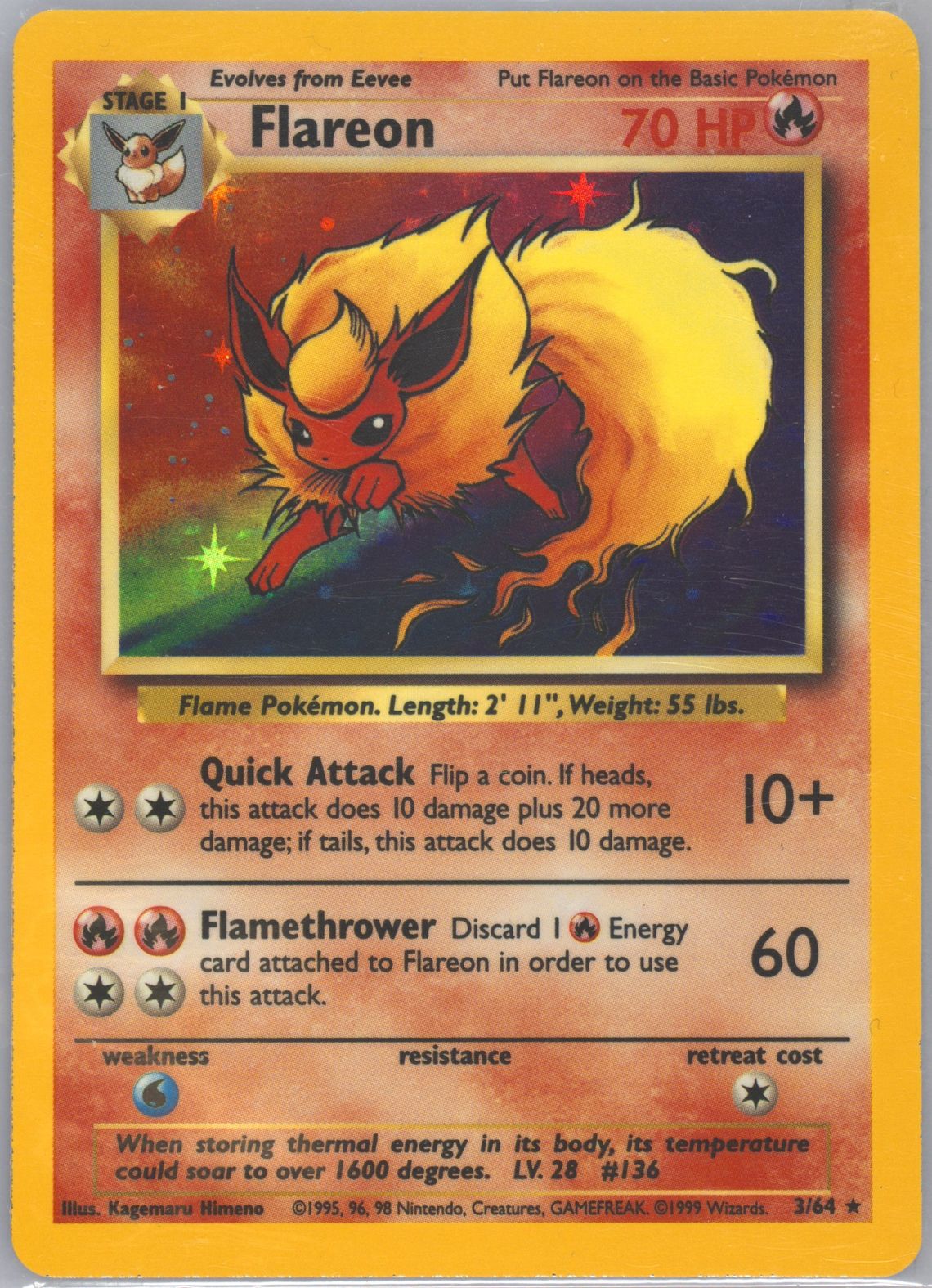
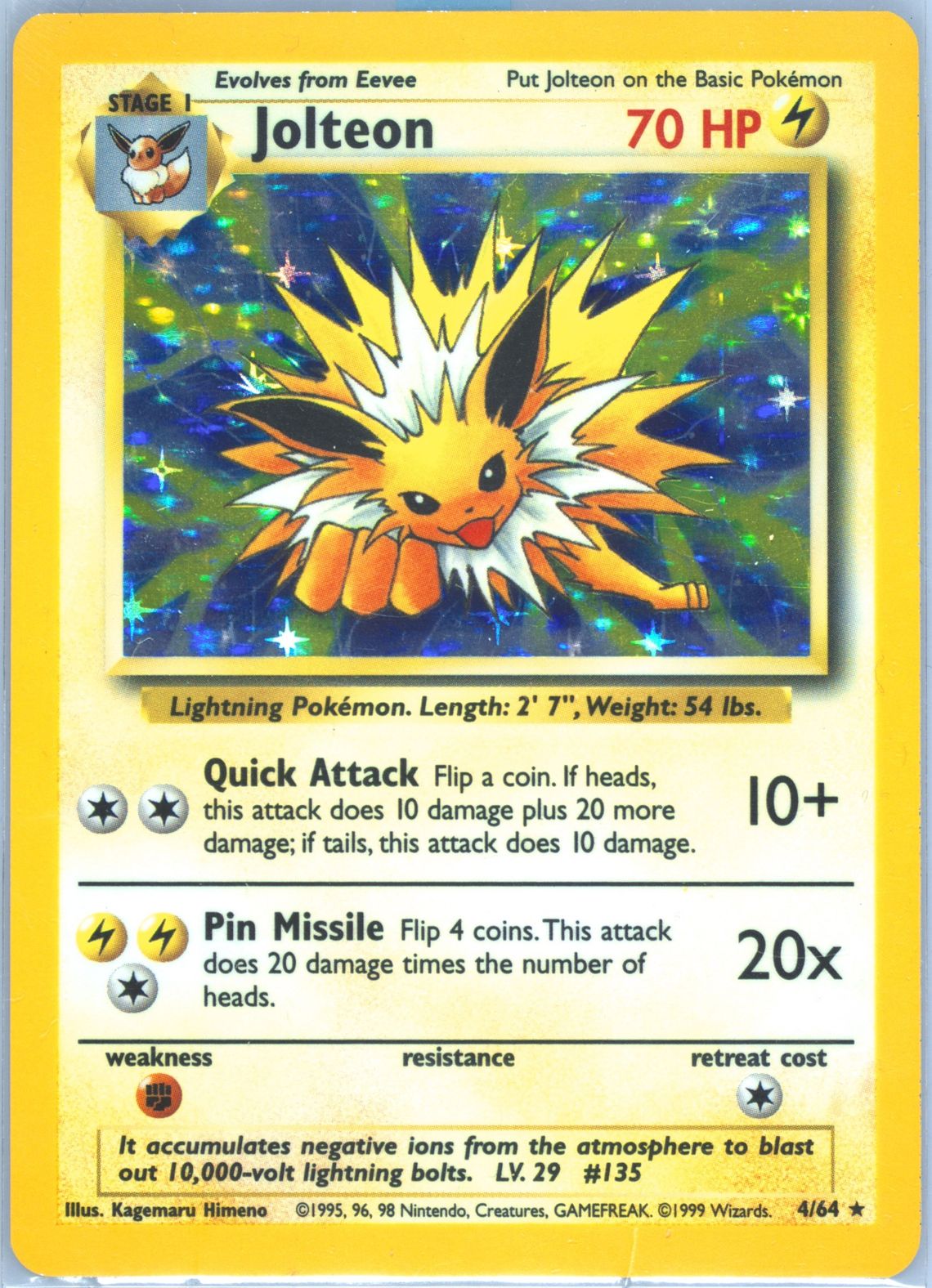
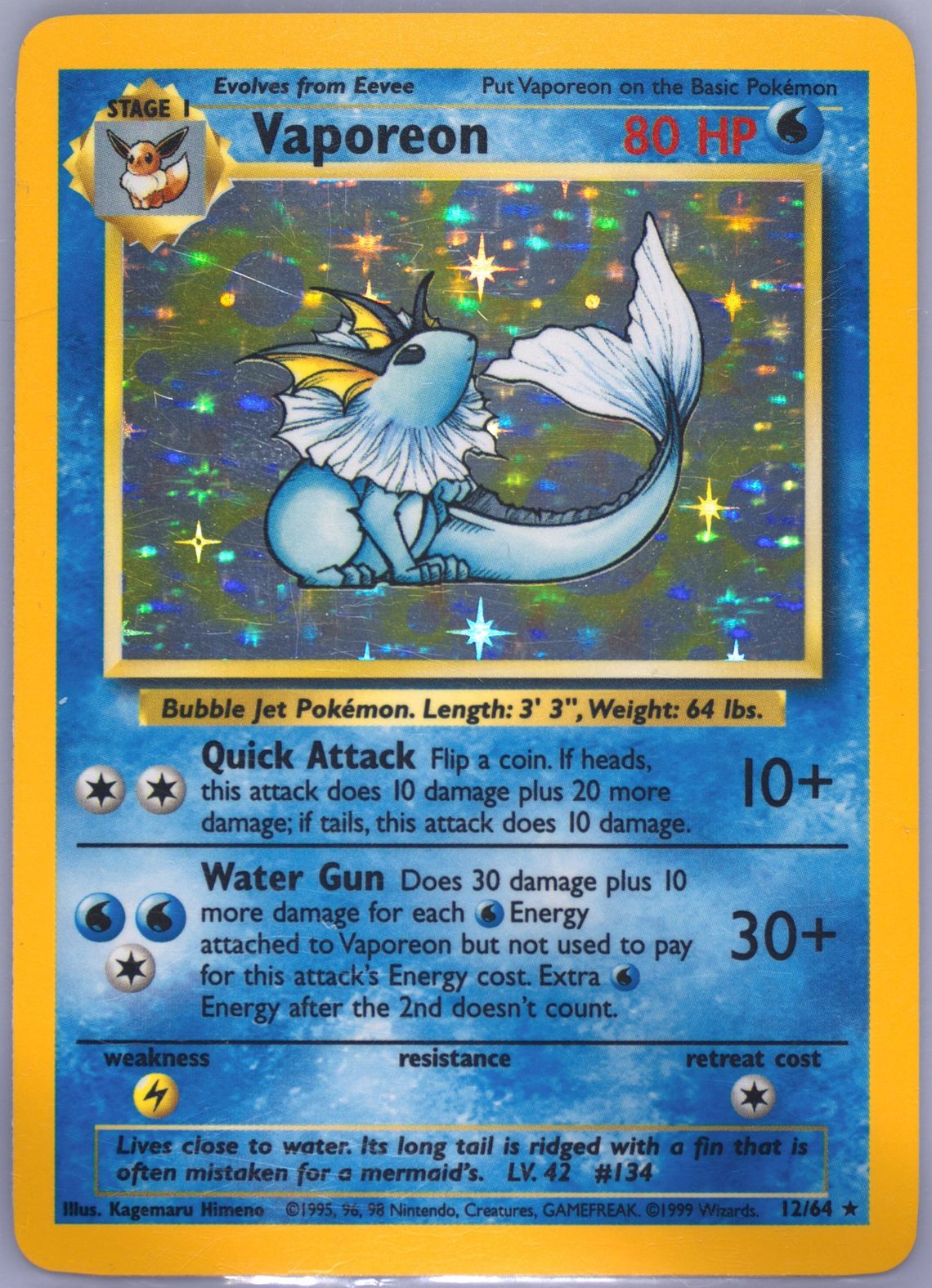
The appeal of no-symbol holos is straightforward: they are visually distinct from the corrected versions (you can spot the missing symbol immediately), they have a clear and well-documented production history, and they exist in large enough quantities that the market is liquid and prices are well-established. A no-symbol Jungle Flareon holo in near-mint condition typically sells in the $500 to $1,500 range, while the most desirable cards in the error set, Jolteon, Vaporeon, and especially the Eeveelution trio as a complete set, can push well above $2,000 to $5,000 in high grades. No-symbol Fossil holos like Gengar and Muk command similar or slightly higher premiums due to their relative scarcity.
For collectors looking to get into error cards without spending five figures, no-symbol Jungle and Fossil holos are the gold standard starting point. The error is well-understood, authentication is relatively straightforward, and the cards themselves are beautiful vintage holos from one of the most beloved eras of the TCG.
Square-Cut Base Set Cards
If no-symbol holos are the gateway drug of error card collecting, square-cut cards are where things start to get serious.
Standard Pokemon cards are die-cut with rounded corners. That is such a fundamental characteristic of the product that most people never even think about it. But occasionally, sheets of cards were cut with a straight guillotine cutter rather than the standard rounded die, producing cards with sharp, 90-degree corners. These "square-cut" cards look dramatically different from their standard counterparts and are immediately recognizable even from across a room.
Square-cut errors can occur in any set from any era, but the most valuable examples come from Base Set, where the combination of iconic card designs and the historical significance of the original set creates a perfect storm of collector demand. A square-cut Base Set holo, particularly a Charizard, Blastoise, or Venusaur, is one of the most sought-after error cards in the entire hobby.
Prices for square-cut Base Set cards vary enormously depending on the specific card and its condition. Common and uncommon Base Set cards with square cuts typically sell in the $100 to $500 range. Rare holos start at around $1,000 and can climb well above $10,000 for the most desirable cards in clean condition. A square-cut 1st Edition Base Set holo, if one were to surface in verifiable condition, would likely command prices in the mid-five-figure range or higher.
The challenge with square-cut cards is authentication. Because the "error" is in the physical cut of the card rather than the print, it is theoretically possible (though difficult) to trim a standard card to mimic a square cut. Reputable grading companies have become increasingly sophisticated at detecting trimmed cards, and buying graded square-cut specimens from PSA or CGC is strongly recommended. Raw square-cut cards from unknown sellers should be approached with caution.
No-Stage Error Blastoise
The no-stage error Blastoise is one of the most famous individual error cards in the hobby and a genuine holy grail for error collectors.
On a standard Blastoise from Base Set, the card reads "Stage 2" above the Pokemon's name, indicating that Blastoise is the final evolution in the Squirtle line. On the no-stage error variant, that "Stage 2" text is completely absent. The card simply reads "Blastoise" with no evolution stage indicated, as if Blastoise were a Basic Pokemon. The error is believed to have occurred on a very small number of sheets early in the Base Set production run, making genuine no-stage Blastoise cards extremely rare.
Authenticated no-stage Blastoise cards have sold for $5,000 to $20,000 or more depending on condition and whether the card is 1st Edition or Unlimited. PSA-graded examples with the error correctly noted on the label command the highest premiums, as the PSA error designation provides both authentication and a clear record of the card's provenance. This is one of those errors where the story alone, a Blastoise that does not know it is supposed to be a Stage 2 Pokemon, adds a layer of charm that collectors find irresistible.
Dramatic Holo Shifts and Misalignment Errors
Holo shift errors occur when the holographic foil layer of a card is misaligned with the printed card surface, causing the shimmering holo pattern to appear shifted to one side, dramatically off-center, or in some extreme cases, bleeding onto adjacent card surfaces in ways that create genuinely bizarre visual effects.
Minor holo shifts are relatively common and add only modest premiums to a card's value. But dramatic holo shifts, where the foil pattern is shifted so far that it fundamentally alters the card's appearance, can be extraordinarily valuable. The most spectacular examples feature the holo pattern shifted completely off the Pokemon's artwork and onto the card's border or text box, or shifted so far that the holo appears to "window" into a section of the card that was never intended to shimmer.
Similarly, off-center cuts where the card's borders are dramatically uneven, showing much more of one edge than the other, or in extreme cases revealing portions of adjacent cards on the uncut sheet, can command significant premiums. A card that is 60/40 off-center might add 10 to 20 percent to the card's value. A card that is 90/10 or worse, where you can see the edge of the next card on the sheet, enters serious error card territory with premiums of $500 or more on top of the base card value.
The most valuable misalignment errors combine dramatic visual impact with desirable base cards. A 90/10 off-center 1st Edition holo from Base Set or an early WOTC expansion is the kind of card that can turn heads at a show and command four-figure prices from the right buyer. The key is that the error needs to be dramatic enough to be obviously unintentional, not just a slightly off-center card that could be mistaken for normal production variance.
Wrong Back and Dual-Front Errors
Wrong back errors are among the rarest and most valuable error types in the entire Pokemon TCG, and for good reason: they represent a fundamental failure in the printing process that should, theoretically, be almost impossible.
A wrong back error occurs when a Pokemon card is printed with the correct Pokemon TCG front but with the back of an entirely different card game, most commonly Magic: The Gathering. This happens when sheets intended for different games are loaded into the press back-to-back, resulting in cards that have a Pokemon front and a Magic back, or vice versa. These errors are exceptionally rare because they require a specific type of production mix-up that quality control is specifically designed to prevent, and most that do occur are caught before the cards leave the factory.
Dual-front errors, where both sides of the card feature a printed front with no back at all, are similarly rare and result from sheets being fed through the press in the wrong orientation.
Verified wrong back Pokemon/Magic cards have sold for anywhere from $2,000 to well over $20,000, with the exact price depending on the specific Pokemon card on the front, the card's condition, and how well-documented the provenance is. A wrong back 1st Edition holo from a WOTC-era set would be, conservatively, a five-figure card, and arguably one of the most significant error cards in the hobby. Even common cards with wrong backs routinely sell for thousands of dollars because the error itself is so rare and so dramatic that the identity of the specific card on the front becomes almost secondary to the error's collectibility.
These are cards where authentication is absolutely critical. The existence of wrong back errors is well-documented, but the extreme prices they command also make them a target for sophisticated forgeries. Buy graded or buy from sellers with impeccable reputations. There is no middle ground here.
Crimped First Edition Cards
Crimping errors occur during the packaging process, when the machine that seals booster packs catches a card in its sealing mechanism and leaves a distinctive ridged impression across the card's surface. The result is a card with a visible, textured crimp mark that typically runs horizontally across the top or bottom of the card, sometimes dramatically distorting the card's surface.
Crimped cards exist on a spectrum. A minor crimp on a common card from a modern set might add $5 to $10 to the card's value. But a dramatic crimp on a 1st Edition holo from a WOTC-era set is a genuinely significant error card that can command premiums of $500 to $5,000 or more, depending on the severity of the crimp and the desirability of the underlying card.
The most valuable crimped cards tend to be ones where the crimp intersects the card's artwork in a visually striking way, or where the crimp is severe enough that the card is clearly damaged by the manufacturing process but still identifiable and displayable. There is an inherent tension in crimped card collecting between the error's severity (more dramatic = more valuable as an error) and the card's visual appeal (too much damage = less displayable), and the cards that thread that needle most effectively tend to command the highest prices.
First Edition crimps are especially prized because the 1st Edition stamp serves as built-in provenance, confirming that the card was produced during the initial print run and that the crimp occurred during original packaging rather than being artificially created after the fact.
Gold Stamp Errors and Prerelease Misplacements
Gold stamp errors encompass a range of mistakes involving the promotional stamps that were applied to cards distributed at prerelease events, league events, and other promotional activities. The most famous gold stamp errors involve prerelease stamps appearing on cards that were never supposed to receive them, or stamps being applied in the wrong location, upside down, or with the wrong text.
The legendary "Prerelease Raichu" from Base Set is perhaps the most famous gold stamp error in Pokemon history, though its existence has been debated for decades. The story goes that a small number of Raichu cards were accidentally given a "PRERELEASE" stamp during a production run intended for a different card. Whether genuine Prerelease Raichu cards actually exist or the whole thing is an elaborate hobby myth remains one of the great unsolved mysteries of Pokemon collecting. If one were ever verified beyond doubt, it would be worth an extraordinary sum.
More commonly, gold stamp errors involve prerelease stamps from one set appearing on cards from a different set, or stamps being placed at odd angles or in wrong positions on otherwise correct cards. These errors are well-documented and verifiable, and they command premiums ranging from a few hundred dollars for minor stamp misplacements to several thousand for dramatic wrong-card stampings. A prerelease stamp on a holo rare from a different set is the kind of error that immediately catches an experienced collector's eye and can generate serious auction competition.
Test Prints and Pre-Production Cards
Test prints and pre-production cards represent the absolute pinnacle of Pokemon error card collecting, both in terms of rarity and price. These are cards that were never intended to enter circulation at all. They are proof sheets, color test prints, production samples, and prototype cards that were produced during the development and setup phases of a print run and were supposed to be destroyed after serving their purpose.
The fact that any of these survived at all is remarkable. Most test prints that exist in collector hands were saved by print shop employees, recovered from waste bins, or acquired through other unofficial channels. Their rarity is genuinely extreme: for some test print types, the total known population is in the single digits.
Test prints come in several varieties. Color test sheets feature cards printed in various color configurations to calibrate the press, sometimes with wildly different color profiles from the final product. Layout proofs show early versions of card designs that differ from the released versions. Uncut sheets that were printed for quality verification and never cut into individual cards are another category, though these are technically production materials rather than error cards.
Prices for test prints and pre-production cards start at around $10,000 for less dramatic examples and can reach well into the six-figure range for the most significant specimens. A complete uncut holo sheet from Base Set, for example, is one of the most valuable Pokemon production artifacts in existence, with verified examples selling for $50,000 to $100,000 or more at major auction houses. Individual test print cards from WOTC-era sets, particularly those showing significant differences from the final released versions, routinely sell for $10,000 to $30,000.
This is the deep end of the error card pool, and it is not for casual collectors. Authentication is extremely difficult, provenance documentation is essential, and the prices involved demand a level of due diligence that goes well beyond checking a PSA label. If you are considering a test print purchase in the five-figure range, consult with multiple experienced error card collectors and authentication experts before committing.
Missing Holo Foil Errors
Missing holo errors are exactly what they sound like: cards that were supposed to be printed with a holographic foil layer but were produced without it, resulting in a "holo rare" that looks like a standard non-holo card. The card has the correct rarity symbol, the correct set number, and all the characteristics of a holo rare except the actual holographic foil.
These errors are more common than some of the exotic categories we have discussed, but they are still genuinely rare in the context of overall production volumes, and they carry a distinctive appeal for collectors who appreciate the cognitive dissonance of a holo that is not actually holographic. The visual effect is surprisingly striking: the card looks almost like a high-quality proxy or a card from an alternate universe where holo foil was never invented.
Missing holo errors from WOTC-era sets are the most valuable, with prices typically ranging from $200 to $2,000 depending on the specific card and condition. A missing holo Base Set Charizard would be an extraordinary find worth well into the four- or five-figure range, though verified examples are extremely rare. Modern missing holo errors exist as well but generally command lower premiums, in the $50 to $500 range, due to the higher print runs and lower nostalgic value of the underlying cards.
Double Crimps and Packaging Errors
Beyond standard single crimps, some cards exhibit double crimps, where the packaging machine caught the card twice, or even more extreme packaging errors where cards were folded, bent, or partially sealed inside the booster pack wrapper itself. These dramatic packaging errors create cards that look almost sculptural in their deformation, and the most extreme examples are prized by collectors who view them as found art as much as collectible cards.
Double-crimped cards from WOTC-era sets, particularly 1st Edition printings, can command $1,000 to $5,000 or more depending on the severity of the error and the identity of the underlying card. Cards that were partially sealed inside wrapper material, creating a "card in wrapper" effect, are even rarer and can push into five-figure territory for the right card.
Packaging errors also include cards found sealed in the wrong product (a holographic rare inside a theme deck that was not supposed to contain holos, for example), or cards from one set found inside sealed product for a different set. These errors are difficult to authenticate after the fact unless they were documented during the opening, which is why pack-opening videos and live-stream openings have become increasingly important for establishing the provenance of packaging errors.
Ink Errors: Missing Colors, Wrong Colors, and Bleed-Through
Ink errors are among the most visually dramatic misprints in the hobby, and they encompass a wide range of production mistakes related to the application of ink during the printing process.
The most common ink errors involve missing colors, where one or more of the CMYK ink layers (cyan, magenta, yellow, or black) fails to apply correctly, resulting in cards with dramatically altered color profiles. A card missing its yellow ink layer will appear with a bluish-purple tint. A card missing cyan will shift toward red and orange. A card missing all color but black will appear as an effectively black-and-white print. The visual effect is immediately noticeable and often stunning, transforming familiar card art into something that looks almost like an alternate art treatment.
Wrong color errors, where the color profile is shifted rather than missing, produce similar visual effects but through a different mechanism. These can result from incorrect ink mixing, press calibration errors, or ink contamination, and the resulting cards can feature color palettes that are subtly or dramatically different from the intended design.
Ink bleed-through errors occur when ink from one side of the card seeps through to the other, creating a ghostly mirror image of the card's back on its front or vice versa. The severity of bleed-through varies enormously, from barely perceptible shadows to dramatic, clearly visible reversed images.
Prices for ink errors depend heavily on the visual impact and the desirability of the base card. A missing color error on a common card from a modern set might sell for $50 to $200. The same error on a WOTC-era holo can command $500 to $3,000 or more. The most dramatic ink errors, those that fundamentally transform the card's appearance in visually striking ways, are the ones that attract the strongest competition from collectors.
WOTC-Era Errors vs. Modern Errors: Which Are More Valuable?
This is one of the most frequently debated topics in the error card community, and the answer is nuanced.
As a general rule, WOTC-era errors (1999-2003) command significantly higher prices than comparable errors from modern sets. There are several reasons for this. First, WOTC-era cards are inherently more scarce than modern cards due to lower print runs, meaning WOTC-era errors are even rarer by comparison. Second, the nostalgia premium that applies to all vintage Pokemon cards applies equally to vintage error cards. Third, quality control during the WOTC era was demonstrably less stringent than modern production, which means that while WOTC-era errors exist in greater variety, each individual error type is still rare enough to be genuinely collectible.
Modern errors, from the Sword and Shield and Scarlet and Violet eras, are more common in absolute terms due to the massive scale of current production. When you are printing billions of cards per year, even a tiny error rate produces a large absolute number of error cards. This higher supply tends to keep prices lower for routine modern errors like minor off-centering or slight crimps.
However, there is an important exception: dramatic modern errors on chase cards can command prices that rival or exceed WOTC-era errors. A spectacular holo shift on a Prismatic Evolutions Umbreon ex Special Illustration Rare, or a crimped Charizard VMAX from Shining Fates, benefits from both the error premium and the underlying card's enormous demand. The most valuable error cards from any era are the ones that combine a dramatic, visually striking error with a highly desirable base card, and that formula works regardless of when the card was printed.
The smartest error card collectors we know do not limit themselves to one era. They look for the most dramatic, most well-documented, and most visually impressive errors regardless of age, and they pay close attention to the underlying card's standalone market value as a baseline for the error premium.
How Grading Companies Handle Error Cards
One of the most important practical considerations for error card collectors is how the major grading companies, PSA, CGC, and BGS, approach error cards. Understanding their different approaches can significantly affect both the authentication and the value of your error cards.
PSA has historically been the most accommodating of the major grading companies when it comes to error cards. PSA will grade error cards and, when the error is recognized and documented, will note the error on the card's label. The "PSA Error" label is highly prized by collectors because it serves as both a grade and an authentication of the error itself. A PSA-graded card with an error notation on the label is essentially a third-party verification that the error is genuine and recognized, which adds significant value and buyer confidence. PSA's error labels have become collectible in their own right, with some collectors specifically seeking out PSA-labeled error cards regardless of the specific error type.
CGC takes a similarly collector-friendly approach to error cards and has built a reputation for being thorough in their error identification. CGC will note errors on the label and has developed a growing library of recognized error types that they can identify and document. For some error types, particularly those that require detailed examination of printing characteristics, CGC's approach has been praised by the error collecting community for its attention to detail. CGC's subgrades also provide useful information about the condition of error cards, which can be helpful for errors that inherently involve some degree of physical damage (like crimps).
BGS (Beckett) grades error cards but has historically been less focused on the error card market than PSA or CGC. BGS will note errors on their labels, but the BGS error card community is smaller than the PSA or CGC communities, which can affect liquidity and resale value.
Our recommendation for grading error cards is to use PSA or CGC depending on the specific error type and your target market. PSA tends to command the highest premiums for WOTC-era error cards due to brand recognition and collector preference in the vintage market. CGC has been gaining ground rapidly, particularly for modern error cards and for error types that benefit from CGC's detailed labeling approach. Whichever service you choose, getting an error card graded by a reputable company is almost always worth the investment, both for authentication purposes and for the value premium that a graded, labeled error card commands over a raw one.
Where to Buy and Sell Misprint and Error Pokemon Cards
The error card market operates somewhat differently from the standard Pokemon card market, and knowing where to transact is essential for both buyers and sellers.
eBay remains the largest and most liquid marketplace for error cards, and it is where the most expensive error card sales tend to occur. The auction format is particularly well-suited to error cards because the unique nature of each error makes fixed pricing difficult, and competitive bidding often drives prices above what a fixed-price listing would have achieved. When searching eBay for error cards, use specific search terms like "pokemon error card," "pokemon misprint," "no symbol jungle holo," or "square cut pokemon" to find relevant listings. Be prepared to do significant due diligence, as eBay's error card listings include both genuine errors and misidentified or fraudulent cards.
Dedicated Facebook groups are where the most knowledgeable error card collectors congregate, and transactions in these groups often benefit from the community's collective expertise in authentication and fair pricing. Groups like "Pokemon Misprints & Errors" and similar communities have active buy/sell/trade threads where some of the most significant error cards change hands. The advantage of these groups is the depth of knowledge among members, many of whom can authenticate error types on sight and can provide realistic pricing guidance. The disadvantage is that these groups can be insular and intimidating for newcomers.
And of course, Misprint. We built this platform specifically for the kinds of transactions that are underserved by general-purpose marketplaces, and error cards are a perfect example. The ability to list cards with detailed descriptions, multiple high-quality photos from every angle, and seller-verified error documentation makes our platform well-suited for error card transactions where visual documentation and trust are paramount. We are actively building out features specifically designed for the error card community, and we are committed to making Misprint the best place to buy and sell Pokemon misprints and error cards.
Auction houses like PWCC, Heritage Auctions, and Goldin handle the highest-end error card sales, typically for cards valued at $5,000 or more. If you have a significant error card and want to maximize your sale price, consignment with a major auction house provides access to the broadest possible pool of high-end buyers and the credibility that comes with a professional auction process.
Warning: Fake Misprints and Artificial Errors
This is the part of the article we wish we did not have to write, but it is the most important section for anyone entering the error card market. Fake misprints are a real and growing problem, and the high prices that genuine error cards command create a powerful incentive for fraud.
The most common types of fake misprints include:
Trimmed cards sold as square cuts. A card that has been trimmed with scissors or a paper cutter to remove the rounded corners can superficially resemble a genuine square-cut error. The difference is detectable under magnification (factory cuts are clean and consistent; hand trims are slightly irregular) and through careful measurement (trimmed cards will be slightly smaller than standard cards), but it requires experience and attention to detail.
Artificial crimps. It is possible to create a crimp-like impression on a card using household tools, and some fraudsters have gotten quite good at mimicking the appearance of genuine packaging crimps. Genuine crimps have a distinctive ridged pattern that is consistent with industrial packaging equipment, and the card fibers will be compressed rather than creased. Artificial crimps tend to have slightly different texture and fiber patterns that an experienced eye can detect.
Sticker or stamp manipulation. Some sellers will add or move prerelease stamps, gold stamps, or other promotional indicators to create the appearance of a gold stamp error. Genuine stamps are applied with specific inks and adhesives that behave differently under UV light and magnification than aftermarket applications.
Chemically altered cards. In the most sophisticated frauds, chemicals are used to remove or alter ink from cards, creating the appearance of missing color errors. These alterations can be extremely difficult to detect without professional-grade equipment and expertise.
Our advice for protecting yourself is straightforward:
- Buy graded whenever possible. A PSA or CGC label with an error notation is the strongest available authentication for an error card.
- Buy from established sellers. In the error card community, reputation is everything. Sellers with long track records of honest dealing and transparent documentation are worth the premium they charge.
- Educate yourself. The more you know about how genuine production errors occur and what they look like, the better equipped you will be to spot fakes. The Facebook error card communities are excellent educational resources.
- Ask questions. Legitimate sellers of genuine error cards are happy to provide additional photos, answer questions about provenance, and explain the nature of the error. Sellers who are evasive or impatient with questions are sellers to avoid.
- If the price seems too good to be true, it probably is. Genuine error cards command premium prices for a reason. A "square-cut Base Set Charizard" listed for $200 is not a bargain; it is a red flag.
Price Trends for Error Cards in Recent Years
The error card market has followed its own trajectory over the past few years, one that diverges in interesting ways from the broader Pokemon TCG market.
During the pandemic-era boom of 2020-2021, error card prices surged along with everything else in the hobby. High-profile error card sales set records across virtually every category, and mainstream attention brought new collectors into the error card community for the first time. The subsequent market correction that affected the broader Pokemon market in 2022-2023 also hit error cards, but notably, the correction was less severe for error cards than for standard cards. The most desirable error cards, the genuinely rare specimens with strong provenance and dramatic visual impact, held their value better than comparable standard cards through the downturn.
Since 2024, the error card market has been in a sustained period of strength. Several factors are driving this trend. First, the growing sophistication of the error card community, supported by better documentation, more active online communities, and improved grading company support, has made the market more accessible and more liquid than it has ever been. Second, the maturation of the broader Pokemon market has pushed collectors toward niches that offer differentiation and discovery potential, and error cards are one of the most compelling of those niches. Third, the increasing rarity of WOTC-era error cards, as more specimens are identified, graded, and locked into long-term collections, has steadily reduced available supply while demand has grown.
We expect these trends to continue. The error card market is still relatively small compared to the standard card market, which means there is significant room for growth as more collectors discover the category. The supply of vintage error cards is fixed and declining as a percentage of what is available for sale, creating fundamental scarcity dynamics that support long-term price appreciation. And the community infrastructure, from dedicated marketplaces like ours to specialized grading services to active online communities, continues to improve, making the market more welcoming and more functional for both new and experienced collectors.
If you are looking for a corner of the Pokemon TCG market that offers genuine scarcity, fascinating stories, and the thrill of owning something truly unique, error cards are hard to beat.
Final Thoughts
Error card collecting occupies a strange and wonderful space in the Pokemon TCG hobby. It is a niche within a niche, a community of collectors who have decided that the most interesting cards are the ones that were never supposed to exist. There is something deeply appealing about that premise, about finding value and beauty in imperfection, about celebrating the moments when the factory got it wrong and accidentally created something rarer and more fascinating than what it was trying to make.
We named our platform Misprint for a reason. The idea that a mistake can become something valuable, that imperfection can be more interesting than perfection, is baked into everything we do. Whether you are hunting for your first no-symbol Jungle holo or negotiating the purchase of a six-figure test print, we are building the tools and the community to support you.
If you have error cards you are looking to sell, or if you are looking to start or expand an error card collection, come check out what we are building. The error card market is growing, the community is welcoming, and the cards themselves are some of the most genuinely fascinating objects in the entire Pokemon TCG hobby.
Happy hunting. And remember: if it looks wrong, it might be worth a lot more than you think.


